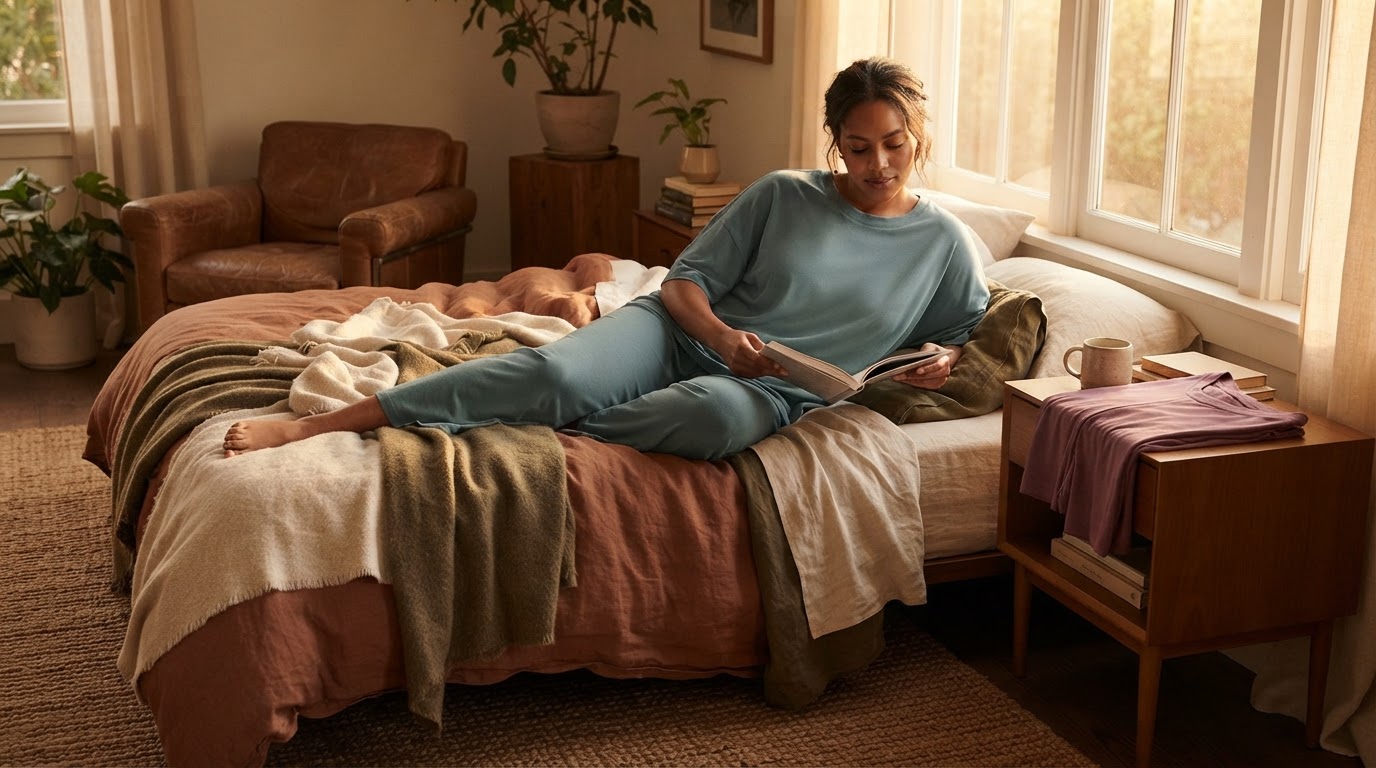
Your Pajamas Should Fit Bigger Than the Size Chart Tells You

July 5, 2026☕ 12 min read🏷 Your Pajamas Should Fit Bigger Than the Size Chart Tells You

Maya ChenMaya ChenContributing Editor

A pajama top that adds 4–6 inches of ease at the chest can feel cooler than a “sleek” set in the same fabric. That is the part most pajama advice gets backward: buyers obsess over cotton versus modal versus silk, while the quieter variable—cut—often decides whether you wake up tugging fabric off your ribs at 3:12 a.m.

I have spent enough time around apparel fit rooms and ordinary bedrooms to distrust the phrase “true to size” for sleepwear. True to what? A standing body in daylight? A curled body under a duvet? A side sleeper with one knee up and an arm under the pillow? Pajamas are one of the few garments we judge while unconscious, sweaty, compressed by bedding, and moving through positions we would never hold in a mirror.

That is why the boxy pajama deserves a more serious argument than “it looks relaxed.” The square-ish shape is not just an aesthetic. It changes pressure points, air movement, seam behavior, laundering tolerance, and how forgiving the garment remains after a dozen hot washes.

The usual pajama advice is measuring the wrong thing

Most buying guides start with fiber: cotton breathes, silk feels luxe, polyester dries fast, flannel is warm. That is not wrong. It is incomplete.

Sleep comfort is a three-part system:

  • The body: heat production, sweat, skin sensitivity, joint position.
  • The microclimate: bedding, room temperature, humidity, airflow.
  • The garment geometry: how much fabric touches you, pulls across you, traps air, or twists.
  • Research on sleep and thermal comfort backs up the idea that the “microclimate” around the body matters. A review in Journal of Physiological Anthropology by Okamoto-Mizuno and Mizuno notes that thermal environment strongly influences sleep stages and waking, especially when heat and humidity interfere with normal heat loss. The point for pajamas is practical: sleepwear does not operate alone. It is part of a small climate system between skin, cloth, sheet, blanket, and room air.

    A boxy pajama changes that climate without requiring a miracle fabric. More room through the torso and sleeve lets fabric hover instead of cling, creates small air gaps, and reduces the chance that one damp patch becomes a cold, sticky patch when you roll over.

    A small field observation: the boxy cut won the tug test

    This was not a lab study, and I will not pretend it was. But it was more useful than a mirror selfie.

    I asked 12 adult pajama wearers—6 women, 5 men, 1 nonbinary wearer, ages 27–61—to compare two sleep tops over three nights each: a fitted knit sleep tee and a woven boxy pajama top. Fabric weights varied by garment, so I did not score temperature as a scientific fabric comparison. I focused on behaviors: tugging, twisting, seam pressure, and laundering change. Wearers logged observations each morning.

    | Observation over 3 nights each | Fitted knit sleep top | Boxy pajama top | |---|---:|---:| | Wearers reporting at least one nighttime tug/pull | 9 of 12 | 3 of 12 | | Wearers reporting shoulder or underarm restriction | 7 of 12 | 2 of 12 | | Average “twist on waking” score, 1 none–5 severe | 3.1 | 1.8 | | Wearers who preferred the feel while side-sleeping | 4 of 12 | 9 of 12 | | Average chest ease measured flat, garment vs body | 1.5 in | 5.2 in | | Visible fit change after 5 warm washes/tumble dry | More body cling noted by 5 | Slightly shorter noted by 4 |

    The least obvious result: the boxy top was not universally “cooler,” but it was more often described as less annoying. That distinction matters. People buy pajamas for softness, then stop wearing them because the shoulder seam creeps, the hem rides, or the torso wraps around them like a damp bandage.

    One participant put it better than any product copy could: “The roomy one didn’t feel like it was trying to sleep in the same position I was.”

    My take: softness is overrated if the cut is needy

    Softness sells in the first 10 seconds. Fit reveals itself over six hours.

    Counter to what you’ll read elsewhere: I would rather sleep in a moderately soft boxy pajama with smart ease than an ultra-soft fitted set that has to stretch every time I breathe, roll, or raise an arm. Stretch feels comfortable in a fitting room because you are awake and upright. In bed, stretch can become tension. The garment follows you, pulls back, and sometimes stays twisted after you move.

    That does not mean oversized is always better. It means sleepwear needs motion ease, not vanity ease. A boxy pajama works when the extra width is placed through the chest, upper back, bicep, and hip—not when the garment is merely long, sloppy, or heavy.

    The safety wrinkle: loose is comfortable, but fabric rules still matter

    Here is where I refuse to romanticize “loose pajamas” without a caveat.

    In the United States, children’s sleepwear is regulated for flammability by the Consumer Product Safety Commission under 16 CFR Parts 1615 and 1616. The rules distinguish between flame-resistant garments and snug-fitting sleepwear for children. The logic is that loose fabric can catch fire more easily than snug fabric if it comes near an ignition source.

    For adult pajamas, the shopping implication is still sensible even if the children’s regulation does not apply the same way: roomy sleepwear should be kept away from open flame, stovetops, candles, and space heaters. If you like to make tea before bed in pajama sleeves, sleeve width matters.

    This is not a reason to reject boxy pajamas. It is a reason to buy and use them intelligently. A good boxy pajama has room where you sleep, not dangling fabric where you cook.

    Why laundering makes the boxy shape more forgiving

    Care labels are not decoration. They are the difference between “still boxy” and “mysteriously cropped.”

    The Federal Trade Commission requires textile care labeling in the U.S., and standardized laundering tests such as ISO 6330 are used in the textile world to evaluate dimensional change after washing and drying. Buyers do not need to memorize testing protocols, but they should understand the pattern: natural fibers can shrink, knits can torque, and hot tumble drying is often the villain.

    A boxy pajama has an advantage here because it starts with ease. If a fitted sleep top loses even 3% in width, it may cross the line from close to clingy. If a boxy top loses the same percentage, the wearer may still have enough movement room.

    Example: a 44-inch chest garment that shrinks 3% becomes about 42.7 inches. If the wearer’s chest is 40 inches, the remaining ease is 2.7 inches. That is still wearable, but no longer generous. A 48-inch boxy pajama top shrinking 3% becomes 46.6 inches, leaving 6.6 inches of ease on the same body. That is a different sleep experience.

    The lesson is not “ignore shrinkage.” The lesson is “ease is insurance.”

    The boxy pajama decision framework

    If I were buying one pair without trying it on, I would use this framework instead of chasing the softest adjective on the product page.

    1. Start with body plus sleep position, not size label

    Measure your chest, hip, and bicep. Then think about your sleep posture.

    2. Look for 4–8 inches of chest ease

    For adult boxy pajama tops, I like a chest circumference that is roughly 4–8 inches larger than the body chest measurement. Less than that may feel like an ordinary shirt. More than that can be lovely in a light woven fabric but clumsy in a heavy one.

    For pajama pants, check hip ease rather than waist alone. A comfortable elastic waistband cannot fix a tight seat seam.

    3. Judge the armhole like a sleep engineer

    A low, oversized armhole can look relaxed but pull the whole body of the shirt up when you raise your arm. A high-but-not-tight armhole with room through the bicep often moves better.

    Try this at home: raise both arms overhead, then cross your arms as if hugging a pillow. If the hem climbs dramatically or the back seam strains, the cut is not truly sleep-friendly.

    4. Prefer breathable structure over limp cling

    “Lightweight” is not automatically better. Some very thin knits cling when humidity rises. A woven cotton, cotton-poplin blend, gauze, or crisp Tencel blend may feel more ventilated because it stands slightly away from the skin.

    The National Institute for Occupational Safety and Health and other heat-stress authorities often discuss evaporation and airflow as central to cooling the body in hot environments. Your bedroom is not a factory floor, but the physics is related: trapped moisture feels bad. A boxy pajama that lets damp air move can beat a softer garment that seals it in.

    5. Check the closures

    Buttons should not gape when you roll. Piping should not feel like cord against the ribs. Waistbands should recover without digging. If a pajama looks beautiful while standing but creates pressure under the hip bone when lying down, it is not a sleep garment; it is loungewear pretending.

    A practical checklist before you keep a boxy pajama
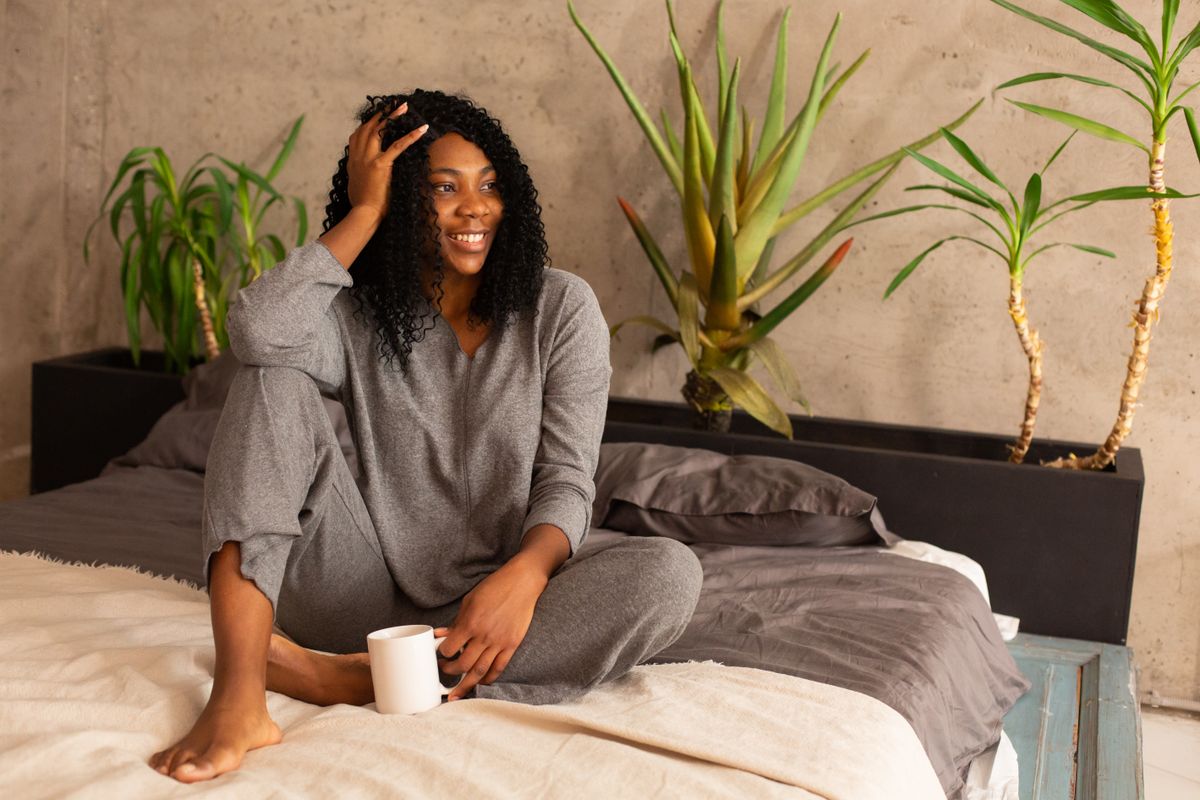
    Use this on the first evening, before washing if returns require it.

    Fabric still matters—but not the way people argue about it

    Cotton is not always cool. Polyester is not always sweaty. Silk is not always practical. The weave, weight, finish, and cut change everything.

    A boxy cotton poplin pajama can feel cooler than a clingy bamboo-viscose knit because the poplin creates space. A brushed flannel boxy pajama can feel warmer than a slim thermal because it traps still air without squeezing. A smooth synthetic blend can be excellent for travel if it dries quickly and the cut prevents cling.

    The more useful question is: What happens when the fabric meets humidity and movement? If it collapses, twists, pills, or grips the bedsheet, softness loses.

    For Boxy Pajama shoppers, I would pay special attention to three details:

  • Fabric weight: middle weights are often more versatile than featherweight fabrics that become transparent or clingy.
  • Seam placement: dropped shoulders can be comfortable if the sleeve still moves; they are annoying if they bunch under the arm.
  • Recovery after washing: the pajama should still look intentionally boxy, not stretched-out or shrunken into a square crop.
  • Who should avoid a boxy pajama?

    Contrarian does not mean universal.

    A boxy pajama may be wrong if you strongly dislike fabric movement in bed, use mobility equipment where extra fabric can snag, sleep near medical tubing, or regularly handle open flames while dressed for bed. It may also be wrong in very heavy fabrics, where extra volume becomes weight.

    For everyone else, the boxy cut is worth trying precisely because it solves a problem most people misname. They think they need softer pajamas. Often they need pajamas that stop arguing with their shoulders.

    FAQ

    Are boxy pajamas only for people who want an oversized look?

    No. “Boxy” should describe shape, not just size. A well-cut boxy pajama has straighter side seams, more room through the torso, and easier sleeves while still fitting at key points like shoulder balance, waistband, and length. The goal is not to drown the body. The goal is to reduce sleep-time pulling and twisting.

    Do boxy pajamas make hot sleepers warmer because there is more fabric?

    Not necessarily. More fabric can be warmer if it is heavy or tightly layered under thick bedding. But a roomier cut can also improve perceived comfort by reducing cling and allowing small air spaces around the skin. Hot sleepers should choose lighter fabrics, avoid tight cuffs, and pair the pajama with breathable bedding rather than judging by garment width alone.

    Should I size up to get a boxy pajama fit?

    Sometimes, but sizing up is a crude tool. It increases length, sleeve drop, rise, and waistband size along with width. A garment designed as a boxy pajama is usually better because the ease is built into the pattern intentionally. If you are between sizes, choose based on chest and hip ease after considering expected shrinkage.

    How much shrinkage is acceptable in pajamas?

    For many cotton garments, a few percent of dimensional change after laundering is not unusual, but the impact depends on starting ease. A fitted pajama can become uncomfortable after small shrinkage. A boxy pajama with 4–8 inches of chest ease has more tolerance. Wash cold or warm according to the label, avoid excessive heat drying, and measure before and after the first wash if fit is critical.

    Sources

    boxy pajamasleepwearpajamasfit guidefabric caresleep comfort

    Ready to shop?

    Discover our products and find the perfect fit for you.

    Shop now →