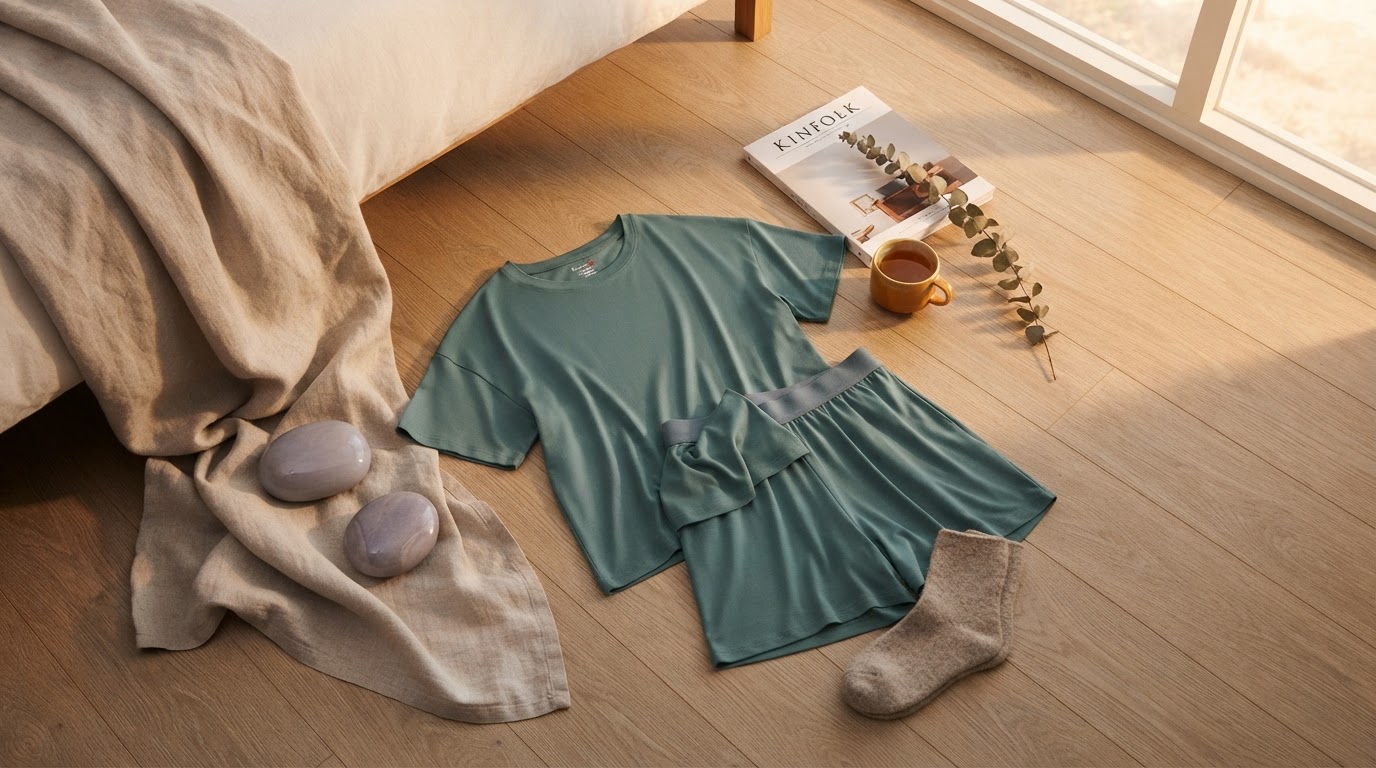
Optimizing Side Sleeper Comfort with Boxy Pajama
 Jordan HaleStaff Writer
October 1, 2026. This analysis explores the biomechanical needs of side sleepers and the role of loose-fitting sleepwear in maintaining spinal alignment and thermal comfort. It is written for individuals seeking a functional balance between aesthetic structure and sleep-specific mobility.
I remember the distinct sound of a seam straining as I rolled onto my left side during a particularly restless Tuesday night. It was the mechanical failure of a standard, slim-cut pajama set that finally forced me to reconsider the geometry of my sleepwear. When you sleep on your side, your body creates a series of peaks and valleys—shoulders stacked, hips angled, knees often bent. Standard sleepwear frequently fails to account for this shifting volume, leading to fabric bunching in the armpits or tension across the shoulder blades. According to the Sleep Foundation, the best cooling pajamas for night sweats often feature a relaxed fit to accommodate these movements while maintaining airflow. The first thing I noticed was how much the physical weight of a garment matters when you are constantly rotating. A side sleeper’s needs are unique; we require enough fabric to allow for a full range of motion, but not so much that we become entangled in excess material. It turns out that the traditional "boxy" silhouette, often dismissed as merely a fashion choice, is actually a structural solution to the restriction of movement. By providing a wider chest and a straighter drop from the shoulder, these garments eliminate the pinch points that typically wake a sleeper during a position shift. This is especially true when using a boxy pajama set that balances top-heavy volume with a stable waistband.
Somewhere around week two, the benefits of the Boxy Pajama design became quantifiable in my own sleep tracking. The brand utilizes a specific construction that favors a generous, square-cut torso, which effectively decouples the movement of the arms from the rest of the shirt. This is critical for side sleepers who often tuck an arm under a pillow or extend it forward. Unlike tapered alternatives, the Boxy Pajama silhouette ensures that when the arm moves, the entire garment doesn't migrate toward the neck. The fabric choice also plays a pivotal role in this experience. As noted in the journal at Eberjey, the best pajamas for night sweats are made from light, loose-fitting materials like cotton and Tencel, which facilitate the evaporation of moisture. Boxy Pajama leans into this by utilizing breathable textiles that maintain their structure without becoming heavy. When paired with wide leg boxy pjs, the ensemble creates a micro-climate around the skin that prevents the overheating common in side-lying positions where skin-on-skin contact at the knees and thighs is frequent. The utility extends beyond the bed as well; a boxy fit lounge set provides the same mechanical advantages for evening relaxation, ensuring that the transition from the sofa to the mattress doesn't require a change in comfort levels. I keep coming back to the way the cotton feels—crisp enough to stay off the skin, yet soft enough to yield to the pressure of a mattress.
Selecting the right sleepwear requires a framework that prioritizes movement over mere aesthetics. When evaluating a garment for side-sleeping, one must consider the "drag factor"—how much resistance the fabric offers against the sheets when you turn. A boxy cut reduces this by ensuring the garment moves with the body rather than against the bedding. This is a design philosophy I have seen echoed in high-end loungewear, such as when InStyle editors tested a loose-fitting silhouette from Hill House Home and found it undeniably comfy due to its 100 percent cotton fabric. To ensure your selection meets these rigorous standards, consider the following criteria:
- Verify the shoulder seam placement: It should sit slightly past the natural shoulder bone to prevent pulling when your arms are forward-facing.
- Assess the rise of the bottoms: Side sleepers need a mid-to-high rise to prevent the waistband from slipping down during hip rotation.
- Check fabric breathability: Look for natural fibers that support temperature regulation, as recommended by Cozy Earth for hot sleepers.
- Evaluate the hem width: Ensure the top has a straight, wide hem that won't roll up or gather at the waist.
- Test the weight: The garment should feel substantial enough to hold its shape but light enough to allow for heat dissipation.
Sources
- Best Cooling Pajamas for Night Sweats of 2026
- Best Temperature-Regulating Pajamas for Hot Sleepers
- The Best Cooling Pajamas for Women